The BMS covers plant. Half the portfolio has no instrumentation. What exists arrives in vendor formats nobody trusts. You cannot integrate your way out of that — there is nothing to integrate. Four reasons estate AI stalls before it starts:

Portfolios are instrumented for plant, not operations. Ask what a floor cost to run last Tuesday - nobody knows.

Raw telemetry is a device ID and a number. No floor, no asset, no definition - so the model inherits noise and reports it back confidently.

Every manufacturer formats differently. Change hardware and the schema fractures, taking your historical baseline with it.

AI owns models. FM owns buildings. The layer between is unowned - and it's why the pilot never reached site two.
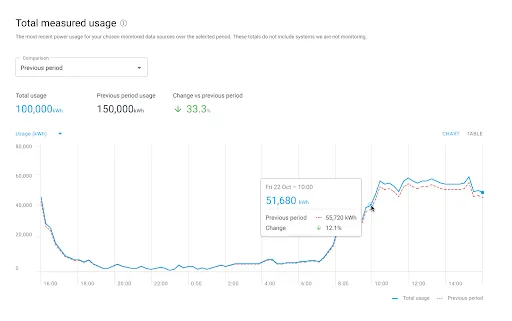

Which sites ran HVAC outside occupied hours last quarter? Unanswerable in most portfolios today. Thirty seconds once the labelling is right.
An alert says something happened. A model says what, how urgent, and what the engineer should bring.
Failure shows in duty cycles and drift weeks before it shows in an outage - if you have been recording consistently.
Compliance, ESG and insurer reporting all need the same thing: a verifiable record. Machine-readable, the audit pack stops being a job — 81% less manual reporting and admin labour on deployed estates.
No interest in owning your models, analytics or applications. Data goes where you need it - API, data platform, CAFM, hyperscaler. Neutrality is a commercial position: the foundation doesn't lock you into an AI decision you will revisit in eighteen months.
AI where it is reliable, and nowhere near anything that has to be exactly right.
Every SLA figure and data-quality metric is produced by code - not inferred, not generated. Anything commercially binding passes a person first.
One event, followed through the layer. Leak detection, already live across BunchTech estates.

Consumption read against occupancy, weather and asset schedules exposes out-of-hours draw and degrading plant. You get a ranked, costed list of measures instead of a hunch. Enabled by Intelligent Energy Monitoring.
Real utilisation, measured continuously rather than surveyed twice a year. Desk ratios, floor consolidation and lease decisions become arguments you can prove. Enabled by Occupancy Monitoring.
Excursions are the symptom; duty-cycle drift is the signal, and it shows far earlier. Intervene on schedule and the compliance record writes itself. Enabled by Cold Storage Monitoring.
Continuous temperature and flushing data replaces the paper record that fails inspection. Assets drifting toward non-compliance are flagged while there is still time to act. Enabled by Legionella Monitoring.
Footfall and consumable data turn a fixed cleaning schedule into a demand-led one. Labour moves where it is needed, and the change is defensible because it is measured.
Conditions tied to occupancy and HVAC behaviour explain complaints instead of logging them, and give the ventilation strategy an evidence base.
Not a dashboard. Not a licence. An operated data layer, under contract.
Hardware-agnostic. The right sensing per asset class, long-range wireless, retrofitted into live buildings without disruption.
Survey, install, commission, verify. Nothing counts as delivered until it is mapped and reporting. This is the part that kills most sensing programmes.
Decoded, normalised, timestamped, labelled. Tied to a floor, zone and asset - not a device ID. One schema across vendors.
We contract on data quality and availability, not boxes shipped. Fleet, battery, triage and lifecycle are ours.
Vaporware fatigue is earned. Most vendors sell a platform and a login, then leave you to work out what to measure and how to model it. That is where programmes stall. Our engineers deploy into your team until the foundation is right.
What actually needs measuring. Which sites first, what density, what to ignore. Most portfolios need less instrumentation than the brief assumes - we would rather say so early.
Schema, naming, tagging, and the mapping of devices to spaces and assets. The least visible part of the work, and the part that decides whether anything downstream can be trusted.
Into your data platform, CAFM, BI layer or models. APIs, delivery patterns, and the validation that proves what arrives is what was sent.
Sensing, data modelling, integration. We build the foundation and hand it over clean.
Your customers are asking what your product does with real building data. Building that in-house means becoming a hardware business.
We run device selection, deployment and fleet operations. You keep the customer, the application layer and the roadmap.
Normalised and consistent across vendors and geographies. Integrate once, not once per manufacturer.
When a deal needs someone credible to scope the hardware and prove the data lands, that is us — under your name. We stop where your product begins.
22+ markets, with radio, regulatory and logistics variation already solved. International estates stop stalling deals.
A continuous, verified record of the estate - decoded into one schema and labelled so every reading ties to a site, floor, zone and asset. Without it, a model has device IDs and no way to reason about them.
No. We build the layer models run on. You use your own AI, analytics or platform partners on top.
That is the common case. Half of most portfolios have nothing beyond plant-level BMS. We survey, design, deploy, and prove every device reports before it counts as delivered.
No. Hardware-agnostic by design, 300+ device types. Existing assets stay where they are producing usable data.
We secure the best outcomes for your tech stack by maintaining a truly hardware-agnostic approach, allowing us to partner and integrate with leading manufacturers and software providers without vendor lock-in.