RICS says a floor-area split may not suit cleaning the common parts. What does your footfall say?

Demand-based cleaning sets cleaning visits from measured footfall instead of a floor plan. In large mixed-use schemes, the RICS service charge standard says a floor-area split may not suit cleaning the public areas, because retail tenants can generate far more footfall than office or residential ones. Measured use is the evidence that a cleaning charge is fair.
A tenant's operations manager emails the centre manager. The cleaning line is up again, and the washrooms nearest their unit are the ones that never seem to be done. The file holds a contract, a rota and a floor-area percentage. The contract says what the contractor was paid to do. Nothing in the file says where the footfall was, or whether the visit happened.
That email used to be uncomfortable. It is harder to answer now, because the standard that managing agents follow asks for charges that can be demonstrated, not asserted.
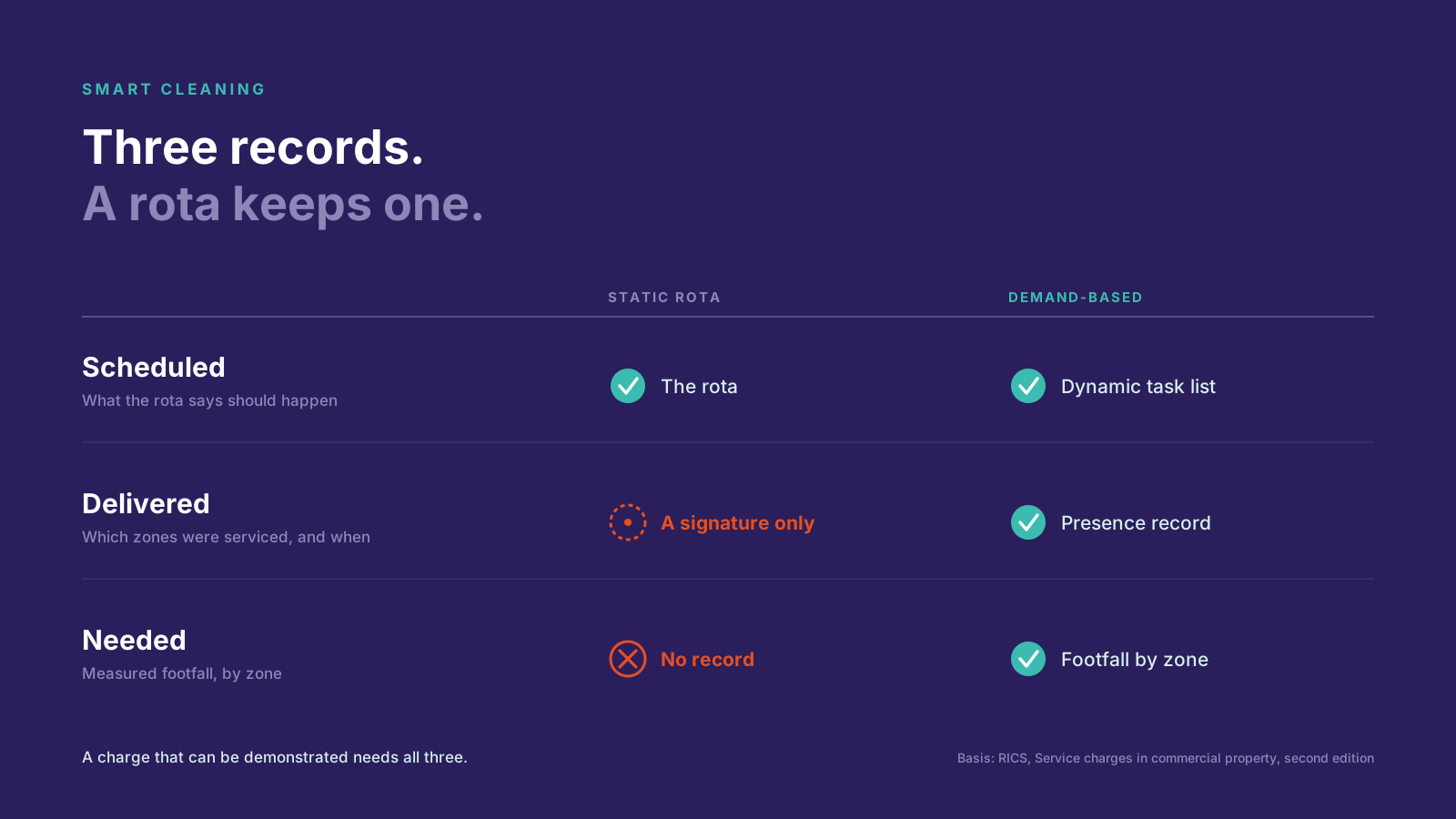
A rota shows what cleaning was scheduled. A service charge needs evidence of what was needed and what was delivered.
What the RICS standard says about cleaning and floor area
In large mixed-use schemes with public common areas, the RICS standard Service charges in commercial property says a direct floor-area comparison may not suit soft services such as cleaning those areas. Retail tenants can generate far more footfall than office or residential tenants. The standard asks for an apportionment that is demonstrably fair and reflects availability, benefit and use.
The standard does not say footfall must set the split. It says the design and layout of a scheme and the hours its tenants trade both matter, and that nobody should assume commercial tenants benefit more. What it asks for is a basis that can be demonstrated. Measured footfall is how you demonstrate it, rather than assert it.
Three further requirements bear on the cleaning line. Managers must seek to recover no more than 100% of the proper and actual cost of the service. They should hold contractors to written performance standards and review performance against them regularly, so they can show that standards are delivered and value for money is achieved. And they should take an open-book approach to tenants' requests for information, using electronic systems where possible.
This is a professional standard, not statute. It binds RICS members and RICS-regulated firms, and it cannot override the lease. It applies to service charge periods starting on or after 31 December 2025, so the budgets being issued for the coming year are drawn up under it. The same standard has a good deal to say about evidencing utilities by meter.
Where a static rota and a floor-area split both miss
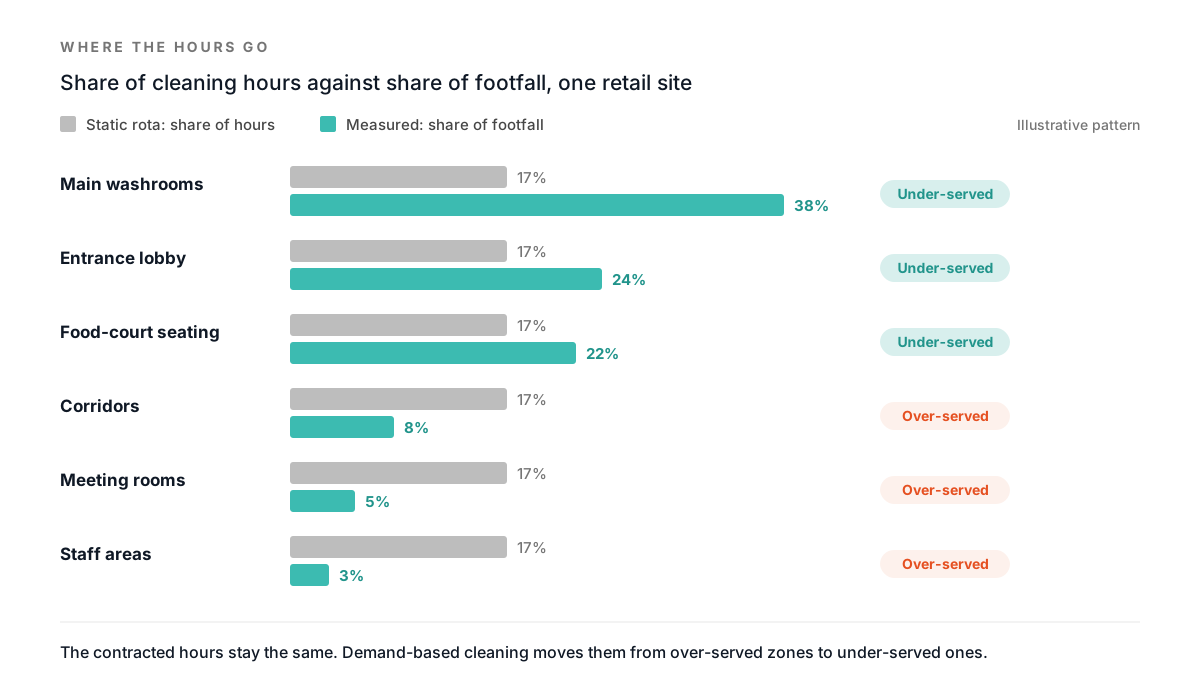
A static rota gives every zone the same visit frequency, and a floor-area split charges every tenant by size rather than by use. Neither records where footfall actually fell. High-traffic washrooms, entrance lobbies and food-court seating get the scheduled visit, and so do meeting rooms that stayed empty.
Seasonal peaks widen the gap, because extra footfall lands on a handful of zones, not evenly across the estate. Consumables follow the same pattern. Washroom stock is replenished on a calendar, so busy sites run short before the visit and quiet sites hold stock they never use. A missed clean has the same flaw: the usual way it gets detected is a complaint, which arrives after the damage is done.
Outcome: deploy the team where the footfall actually is
The problem it solves. A rota written around a floor plan visits empty rooms on schedule and reaches the busiest washrooms after the footfall has peaked.
What changes:
- Anonymous occupancy sensors and door counters measure use by zone through the day, site by site
- Dynamic task lists trigger cleaning from measured use instead of from the calendar
- The rota is rebuilt from the data every week, so a peak week and a quiet week are treated differently
The outcome. The contracted hours stay the same. They land where the traffic is, and the cleaning line rests on measured use.
Deployment reality: live reporting from day 90 across the estate.
Solution: Smart Cleaning.
Outcome: stock the washrooms from use, not from the calendar
The problem it solves. Soap and towel dispensers run empty at the busiest sites between visits, while quiet sites are restocked on schedule.
What changes:
- Dispenser levels tracked continuously, so stock is a measured quantity
- A low-level alert sent to the team on site, ahead of the scheduled visit
- Replenishment routed by use, so supplies and visits go where the traffic is
The outcome. Fewer empty dispensers at peak, and no stock held for sites that do not use it.
Deployment reality: dispenser tracking live from day 90, alongside the zone data.
Solution: Smart Cleaning.
Proof of presence: the record behind the charge

Proof of presence records which zones were serviced and when, so contractor performance becomes a data set instead of a signed sheet. It gives the manager the delivery evidence the standard asks for, and it gives a tenant's query an answer that fits in an email.
A signature proves someone signed. A presence record proves someone was there. For a service charge, that is the difference between a charge that is asserted and one that is evidenced. The failure it replaces is a familiar one: a tenant says the clean did not happen, the sheet says it did, and nobody can settle it. BunchTech's work with Arcus FM delivered up to an 81% reduction in compliance reporting labour.
Outcome: replace the signed sheet with proof of presence
The problem it solves. A signed rota sheet that says the clean happened, a tenant who says it did not, and no record that settles it.
What changes:
- Areas serviced and timing captured by zone, with a timestamp for every visit
- A missed visit flagged the same shift and raised as a work order in your existing CAFM, with occupant feedback panels at washroom exits adding a same-day signal
- The monthly performance report generated from the data instead of compiled by hand
The outcome. Tenant queries are settled by the record, and reporting labour falls by up to 81% (Arcus FM).
Deployment reality: validated data at day 60.
Solution: Smart Cleaning.
What to specify at renewal, as cleaning costs rise
Cleaning is priced on labour hours, so wage rises reach the service charge at renewal. The National Living Wage is £12.71 an hour from 1 April 2026, up from £12.21. On 15 October 2026 the Living Wage Foundation announced the real Living Wage at £14.10 outside London and £15.45 in London.
The two rates bind differently. The National Living Wage applies to every employer. The real Living Wage is voluntary, and reaches your contract only where the contractor is accredited or your specification requires it. Accredited employers must implement the new rate by 1 May 2027.
Put the uplift against one scheme. Take a scheme that buys 20,000 cleaning hours a year. A 65p rise adds £13,000 in wages alone, before employer National Insurance, holiday pay and pension, and the 50p statutory rise in April added £10,000. This is illustrative arithmetic, so use your own hours. That cost lands in the cleaning line, and the standard says managers should tell tenants promptly when a significant variance against budget is likely.
The rate is not the lever you control. The evidence is. Write measured outcomes into the specification at renewal, and renewals before 1 May 2027 are the natural point, because prices are being reset anyway. The standard also expects contracts to be re-tendered or competitively priced about every three years.
- Visit frequency. Static rota contract: fixed per room at tender. Demand-based contract: set per zone from measured footfall, reviewed quarterly.
- Evidence of a clean. Static rota contract: signed sheet. Demand-based contract: timestamped proof of presence.
- A missed visit. Static rota contract: found by complaint. Demand-based contract: flagged the same shift as a work order.
- Performance report. Static rota contract: compiled by hand. Demand-based contract: generated from the data.
- Basis for the cleaning line. Static rota contract: floor area and the hourly rate. Demand-based contract: measured use and the hours deployed per zone.
Deployment follows the same gated model used elsewhere. Day 1 is contract, provisioning and device selection per zone. Day 30, installs are booked and site prep is complete. Day 60, installation is complete and the data is validated. Day 90, the live dashboard and handover. Devices are warehoused and pre-configured before dispatch, so your cleaning contractor does not become the install crew, and the engineers who fit the sensors are BunchTech's. A 335-site, roughly 6,000-sensor rollout ran on that model in seven months.
A contract that can show where its hours went is the one that can defend its line in the budget.
Where to start
The first step is not replacing the contractor. It is measuring one thing the rota and the floor-area split cannot: which zones are actually used, and when.
Get your IoT audit — thirty minutes, no obligation, and you finish with a scoped plan for your estate: which sites and zones get sensors, what a proof-of-presence record would replace in your current reporting, and the gate dates for day 30, 60 and 90.