
Your building closes for Christmas. Your Legionella flushing regime cannot.
HSG274 Part 2 says infrequently used equipment, meaning anything unused for seven days or more, belongs on a flushing regime, with weekly flushing recommended. A closure of more than a week puts every outlet in an empty building on that regime. Flushing is the control. A continuous temperature record is the evidence that it ran.

The office closes at 5pm on Christmas Eve. The cleaners leave and the engineers are off until the second. Every tap, shower and washbasin above the ground floor stops being used, and the water in the branches behind them starts to stand.
On the second of January the building reopens. Somebody asks whether the flush was done. The logbook has a blank week, or a tick nobody can back up.
A flushing regime is a control. A continuous temperature record is the evidence that the control ran.
What HSG274 says about buildings that stand empty

HSE's guidance HSG274 Part 2 treats stagnation as a risk in buildings that are not fully occupied or are used intermittently. Equipment not used for seven days or more should be on a flushing regime. Weekly flushing for several minutes can significantly reduce legionella proliferation, and outlets should be run until the temperature stabilises and matches the supply water.
A closure that runs past a week therefore puts every outlet on the regime. On the weekly baseline the arithmetic is simple:
- A 10-day closure has one weekly flush due
- A 17-day closure has two
- A 24-day closure has three
The risk assessment can set another frequency, and HSG274 also says infrequently used showers and taps should be considered for removal. What it does not do is treat a closure as an exemption. Non-occupancy is a risk to be managed.
Christmas is the visible case. The quieter one runs all year. A vacant unit between lettings is a building full of infrequently used outlets. So are the staff washrooms nobody has used since the rota changed, and the upper floors of a half-let office. Any of them can sit on the regime without anyone having decided that they should.
Legionella multiplies in water between 20°C and 45°C. Standing water drifts towards the temperature of the space around it. For hot water that means leaving the safe range, and for cold water it means warming towards the range where legionella grows.
Where a paper flush log fails in a closed estate
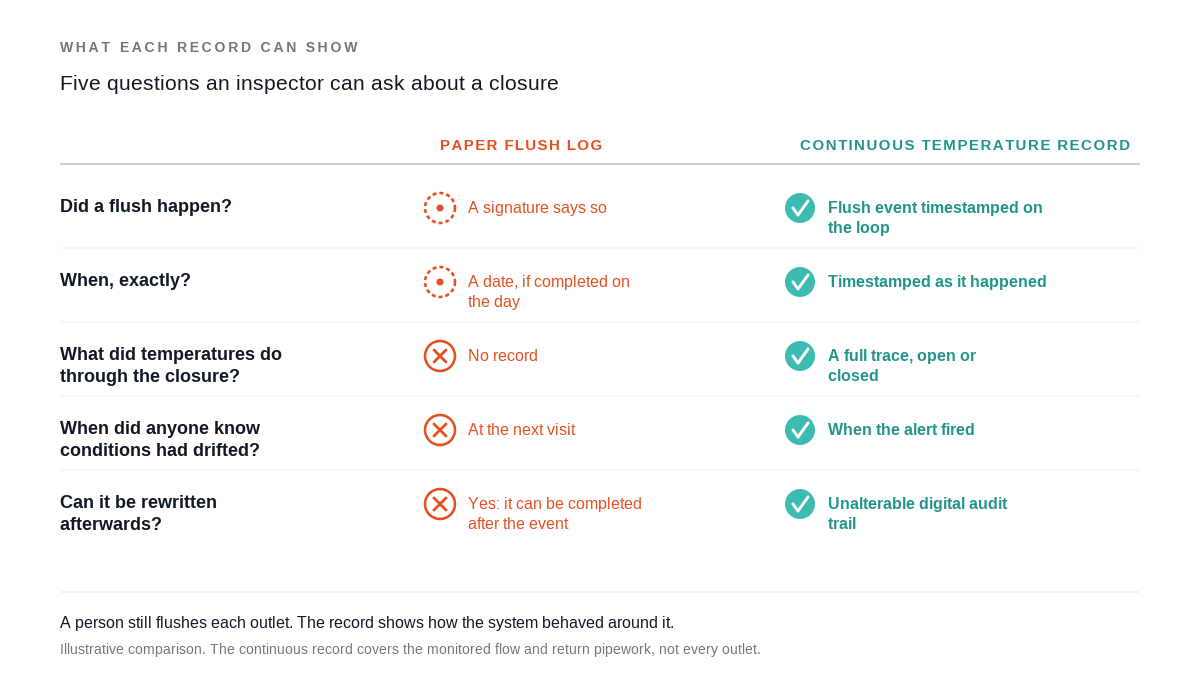
A flush needs a person at the outlet, and a closed building is when nobody is there. A paper log records a signature and a date. It does not show that water ran, for how long, or what the system's temperatures did before and after. That is the gap an inspector finds.
The prosecution record shows where this ends. In December 2024 Amey Community Limited, the facilities management provider at HMP Lincoln, was fined £600,000 after pleading guilty to a breach of section 3(1) of the Health and Safety at Work etc. Act 1974. HSE found that it had not acted on a 2016 risk assessment, had no written scheme for preventing and controlling legionella, and had neither maintained appropriate water temperatures nor monitored them across October and November 2017. A prisoner died of Legionnaires' disease in December 2017.
Across an estate the question gets sharper. Christmas week is when contractor cover, keyholders and site access are thinnest, and it is the week in which the regime most needs a named owner at every site. The test is simple: how many sites can name the person who flushes this week, and show what they did?
Amey is not a Christmas-closure case, and a prison is not a retail park. The relevance is narrower. HSE prosecuted the contractor that provided facilities management services at the site. The failures were an unacted assessment and no temperature monitoring.
Outcome: see the system's temperatures through the closure
The problem it solves. Nobody sees the water system between the last signature before closure and the first one after.
What changes:
- Temperature sensors on flow and return pipework record continuously, whether the building is open or closed
- Instant alerts when conditions favour Legionella proliferation
- Historical logging that shows the temperature trace across the whole closure
The outcome. You learn on 27 December what you would otherwise learn on 2 January.
Deployment reality: live dashboard at day 90, which is why this cannot be in place by 24 December.
Solution: Legionella Monitoring.
Outcome: evidence that a flush happened
The problem it solves. A tick on a sheet with nothing behind it.
What changes:
- Flush events identified from the temperature record on the monitored pipework, with a timestamp
- A person still flushes each outlet, and the monitored data shows the system behaved as expected around it
- Flush events and temperatures held together, so the sequence can be reviewed
The outcome. The record shows that water moved on the loop, and when. A signature shows only that someone signed.
Deployment reality: validated data at day 60.
Solution: Legionella Monitoring.
Outcome: an audit trail that cannot be rewritten
The problem it solves. A paper logbook that can be completed after the event.
What changes:
- Temperatures and events written to a digital audit trail as they happen
- Reports generated from the record instead of compiled by hand
- Records available by site and by date, without a call to a keyholder
The outcome. An unalterable digital audit trail in place of a logbook.
Deployment reality: continuous record from day 90.
Solution: Legionella Monitoring.
What to do before 24 December
A monitoring deployment will not be live by Christmas. BunchTech works to fixed gates, with the live dashboard at day 90, so December belongs to the manual regime done properly. List the infrequently used outlets and dead legs from the risk assessment, name a flush owner and a cover for each site, and use the frequency the assessment supports.
- Identify every outlet that will go unused for seven days or more, including showers and remote washbasins
- Name the person who flushes each site and the person who covers them
- Run each outlet until the temperature stabilises, and write the time and temperature down
- Check the system on the first working day, before the building is fully reoccupied
A flush record that stands up names the outlet, the date, the start and end times, the temperature reached and the person who did it. A record that says "flushed" and nothing else is a signature with extra steps. The reopening check matters because the first people back through the door draw the water that has stood longest.
Then scope monitoring for the first quarter, starting with the sites that close over Christmas and the sites that stand partly empty all year. The logic is the one that applies to a freezer: two checks a day cannot see the hours in between, and one signature a week cannot see the days in between.
Get your IoT audit — thirty minutes, no obligation, and you finish with a scoped deployment plan: which sites and which loops, and the gate dates for day 30, 60 and 90.